
WSET Level 3 soils are one of the few parts of the syllabus where a single fact — which ground a vine grows in — explains drainage, heat, vigour, ripeness, and ultimately the style in the glass, which is exactly why examiners keep coming back to it. This guide walks every country and region in the WSET Level 3 in Wines syllabus and gives you the soil, the mechanism behind it, and the style consequence you are expected to write in a short-answer question. Read it once for the map, then a second time testing yourself region by region, and you will have the whole soil picture in one place.
Before the regions, fix the four principles every soil answer should hang on, because the examiner is never really asking "what is the soil" — they are asking "what does the soil do." Keep the Cabernet Sauvignon dossier and the Riesling dossier open as you read; both varieties show up repeatedly as the textbook example of a soil's effect.
The four things soil actually does (learn these first)
Every soil fact in the syllabus reduces to one of four levers, and naming the lever is what earns the mark.
- Drainage. Free-draining soils (gravel, sand, slate, schist) stress the vine slightly, push roots down, limit vigour, and concentrate fruit. Water-retentive soils (clay) keep vines supplied in drought but risk excess vigour and dilution in wet years.
- Heat. Stony soils (gravel, galets, slate, terra rossa over limestone) absorb daytime warmth and radiate it back at night, aiding ripening in marginal climates. Pale, reflective soils (chalk, albariza) bounce sunlight up into the canopy.
- Water holding in drought. Chalk and limestone hold a reservoir of water yet still drain freely — the reason chalky regions ripen reliably through dry summers without irrigation.
- Vigour / nutrients. Poor, low-nutrient soils (slate, schist, sand, granite) limit yields and raise concentration; fertile alluvial valley floors raise yields and can dilute quality unless managed.
When you reach for a soil in an answer, state the soil, then the lever, then the style: "Médoc gravel drains freely and retains heat, ripening late-budding Cabernet Sauvignon and limiting vigour, giving concentrated, structured wines."
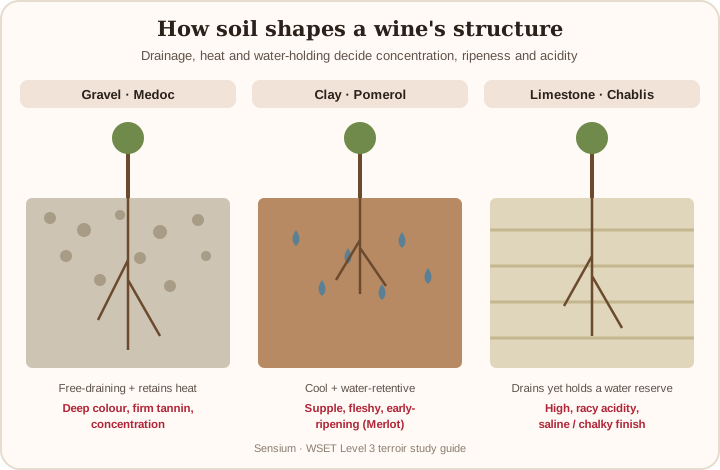
France — Bordeaux
Bordeaux is the cleanest illustration of soil driving the blend, and the Left Bank / Right Bank split is a guaranteed exam theme.
- Left Bank (Médoc, Haut-Médoc, Graves, Pessac-Léognan): deep gravel mounds (croupes) deposited by the Gironde. Gravel drains fast, retains heat, and forces deep rooting — perfect for late-ripening, drainage-hungry Cabernet Sauvignon, which dominates Left Bank blends. The best châteaux sit on the deepest gravel banks closest to the river.
- Right Bank (Pomerol, Saint-Émilion): cooler, more water-retentive clay and limestone. Clay suits early-ripening Merlot and Cabernet Franc, which keep moisture-supplied and ripen ahead of frost. Pomerol's famed iron-rich clay (the "crasse de fer") underlies its most concentrated wines; the Saint-Émilion limestone plateau gives structure and freshness.
- Entre-Deux-Mers: clay and limestone over a wider, more fertile base — higher-volume whites and everyday reds.
Exam shorthand: gravel = Cabernet = Left Bank; clay/limestone = Merlot = Right Bank.
France — Burgundy
Burgundy's reputation for site-by-site precision is, at bottom, a limestone-and-marl story along the Côte d'Or escarpment.
- Chablis: Kimmeridgian soil — limestone and clay packed with fossilised marine oysters (Exogyra virgula), credited with Chablis's saline, mineral edge in Chardonnay. The flatter, younger Portlandian limestone is reserved for Petit Chablis.
- Côte d'Or (Côte de Nuits + Côte de Beaune): a band of limestone and marl (clay-limestone). Mid-slope sites have the ideal mix of drainage, shallow soil, and sun exposure, which is why Grands Crus sit mid-slope; the richer clay at the bottom and the thin scree at the top give lesser appellations. Pinot Noir and Chardonnay both express these limestone gradients.
- Côte Chalonnaise / Mâconnais: similar limestone-clay, less consistently drained, generally higher yields and earlier-drinking styles.
France — Rhône Valley
The Rhône gives you two contrasting soil set-pieces.
- Northern Rhône: steep granite slopes (Hermitage, Côte-Rôtie, Cornas). Granite is poor and free-draining, limiting vigour and giving structured, mineral Syrah. Côte-Rôtie's Côte Brune (iron-rich schist/clay) versus Côte Blonde (lighter granite/limestone) is a classic aspect-and-soil contrast.
- Southern Rhône (Châteauneuf-du-Pape): the iconic galets roulés — large rounded quartzite pebbles deposited by the Rhône that store the day's heat and radiate it overnight, helping ripen Grenache. Note that Châteauneuf is mixed: galets sit alongside sand (giving more elegant, perfumed wines) and limestone/clay, so not every famous vineyard is pebbly.
France — Loire Valley
The Loire is a soil traverse from Atlantic to continental, and Sancerre alone is a three-soil exam question.
- Muscadet (Pays Nantais): gneiss, granite, and schist near the Atlantic, often with lees ageing (sur lie) for texture in Melon de Bourgogne.
- Anjou-Saumur / Touraine: tuffeau (a soft, porous limestone) and schist; tuffeau gives the freshness and ageing capacity of Vouvray and Saumur Chenin Blanc.
- Sancerre & Pouilly-Fumé: three named soils for Sauvignon Blanc — terres blanches (Kimmeridgian marl, broad and structured), caillottes (shallow limestone gravel, aromatic and early), and silex (flint, giving the smoky/gunflint note Pouilly-Fumé is named for).
France — Alsace, Champagne, and the South
- Alsace: the most varied soils on the syllabus — granite, limestone, schist, sandstone, clay, and volcanic rock — which is why the 51 Grands Crus each claim a distinct signature. Riesling on granite reads steely and floral; on limestone, broader and riper; on volcanic, smoky. Use Alsace as your example of soil diversity within one region.
- Champagne: chalk (belemnite and micraster), most famously the Côte des Blancs for Chardonnay. Chalk drains freely yet holds a deep water reserve, ripening grapes in a cool, marginal climate and storing the region's bottle-aged stocks in cool cellars cut into it.
- Languedoc-Roussillon: a patchwork of limestone, schist, gravel, and clay; the schist of areas like Roussillon and parts of the Languedoc gives concentration and minerality to Grenache, Syrah, and Carignan.
- South West France: gravel, clay, and limestone echoing nearby Bordeaux, with Malbec on the clay-limestone of Cahors and Tannat in Madiran.
Germany
Germany is the slope-and-soil region, and the Mosel slate answer is almost guaranteed.
- Mosel: steep Devonian slate (blue, grey, and red). Slate is dark, so it absorbs heat and radiates it back to ripen Riesling on near-vertical south-facing slopes in a cool climate; it also drains the frequent rain and forces deep rooting. Red slate (Rotschiefer) versus blue slate (Blauschiefer) is a recognised stylistic nuance.
- Rheingau: mixed slate, quartzite, and loess, on south-facing slopes above the Rhine for fuller-bodied Riesling.
- Pfalz / Rheinhessen / Baden: warmer, more varied — loess, limestone, sandstone, and volcanic soils giving riper Riesling, Pinot Noir (Spätburgunder), and Pinot Gris/Blanc.
Exam shorthand: dark slate = heat absorption + drainage + steep-slope Riesling.
Austria and Hungary
- Austria (Wachau, Kremstal, Kamptal): terraced primary rock (gneiss, granite, schist) on the steep slopes for mineral, structured Grüner Veltliner and Riesling, with wind-blown loess on the lower terraces giving broader, riper Grüner. The loess-vs-primary-rock contrast is the key Wachau distinction.
- Burgenland: clay and limestone around the warming Neusiedlersee for Blaufränkisch reds and botrytised sweet wines.
- Hungary (Tokaj): volcanic bedrock with clay and loess; the volcanic soils plus autumn mists off the Bodrog and Tisza rivers (botrytis) underpin the sweet Furmint of Tokaji Aszú.
Italy
Italy gives you three set-piece soils: Barolo's marl, Tuscany's galestro, and Soave's volcanic basalt.
- Piedmont (Barolo/Barbaresco): calcareous marl (limestone-clay). The Tortonian marls of La Morra and Barolo village give more perfumed, earlier-drinking Nebbiolo; the older Serravallian/Helvetian marls of Serralunga d'Alba and Monforte give more structured, longer-lived wines. This soil-age split is a favourite exam contrast.
- Tuscany (Chianti, Brunello): galestro (a friable, flaky clay-schist) and alberese (hard limestone), giving freshness and structure to Sangiovese. Bolgheri on the coast adds gravel and sand for Bordeaux varieties.
- Veneto (Soave): volcanic basalt and limestone for Garganega; the volcanic soils give Soave Classico its mineral depth.
- The South (Campania, Sicily, Basilicata): volcanic soils on Mount Etna and Vesuvius, and around Mount Vulture for Aglianico; volcanic ash and lava give freshness and structure in a hot climate.
Spain
- Rioja: clay-limestone in the cooler, higher Rioja Alta and Rioja Alavesa (structured, age-worthy Tempranillo), shifting to iron-rich clay and warmer alluvial soils in the lower Rioja Oriental (riper, softer Garnacha-led wines).
- Ribera del Duero: limestone, clay, and sand on a high plateau — limestone gives structure and freshness to Tempranillo (Tinto Fino) despite the heat.
- Priorat: llicorella — a striking black slate and quartzite that forces vines to root deep for water, giving tiny yields and intensely concentrated, mineral Garnacha and Cariñena.
- Rías Baixas: granite and sandy topsoil in a wet Atlantic climate; free-draining granite and pergola training fight the humidity for crisp Albariño.
- Jerez (Sherry): albariza — a brilliant-white, chalky soil very high in calcium carbonate. It reflects sunlight, and crucially soaks up the winter rains and forms a hard crust in summer that locks moisture underground, sustaining Palomino vines through the rain-free Andalusian summer. Lesser soils are barros (clay) and arenas (sand).
Exam shorthand: albariza = white chalk = water reservoir for the dry Sherry summer; llicorella = black slate = deep rooting + low yields.
Portugal
- Douro (Port and dry reds): schist bedrock, fractured vertically so vine roots drive deep through the cracks to find water on the terraced, baking slopes — essential in a hot, dry valley. Patches of granite appear but schist is the quality soil for Touriga Nacional.
- Vinho Verde: granite and sandy soils in the wet, green northwest for crisp, light whites.
- Madeira: volcanic basalt soils on steep terraces.
Greece
- Santorini: volcanic pumice, ash, and pozzolana with effectively no clay. The soil is so sandy/volcanic that phylloxera cannot survive, so vines are ungrafted and ancient; the porous volcanic ground plus the kouloura basket training protect bone-dry, high-acid Assyrtiko. Santorini is the syllabus's headline volcanic-and-phylloxera-free example.
- Naoussa / Nemea (mainland): limestone, clay, and sandy soils for Xinomavro and Agiorgitiko.
United States
- California — Napa Valley: famously diverse (dozens of soil series in one valley): volcanic soils on the hillside AVAs (Howell Mountain, Mount Veeder), alluvial gravel and loam on the valley-floor benches (the Rutherford "dust"), and clay near the cooler south. Hillside volcanic soils give structure; benchland alluvium gives generous, ripe Cabernet Sauvignon.
- California — Sonoma / Central Coast: mixed alluvial, sandstone, and some volcanic; the Petaluma Gap and coastal sites layer fog and soil together.
- Oregon (Willamette Valley): two headline soils for Pinot Noir — Jory (volcanic, basalt-derived, red) and Willakenzie (marine sedimentary, sandstone) — a recognised stylistic split.
- Washington (Columbia Valley): sandy, free-draining soils over basalt, shaped by the ancient Missoula Floods; sandy soils are phylloxera-resistant and let vines own-root.
Canada
- Niagara Peninsula: limestone, clay, and shale soils moderated by Lake Ontario and the Niagara Escarpment, for Riesling, Chardonnay, and icewine.
- Okanagan Valley (BC): varied glacial, sandy, and gravelly soils along a north-south lake corridor.
Chile
- Central Valley (Maipo, Rapel, Colchagua): alluvial soils of sand, clay, gravel, and silt washed down from the Andes — fertile valley floors give volume; gravelly hillside and alluvial-fan sites give quality Cabernet Sauvignon and Carmenère.
- Coastal (Casablanca, San Antonio, Limarí): granite, clay, and limestone; Limarí's limestone is prized for mineral Chardonnay.
Argentina
- Mendoza (incl. Uco Valley): alluvial soils of sand, silt, and clay deposited by Andean rivers, increasingly prized for calcareous (calcium-carbonate) patches at altitude — the limestone of Gualtallary in the Uco Valley is the headline high-end Malbec soil. Free-draining, low-fertility alluvium plus desert sun gives concentrated Malbec.
- Salta (Cafayate): sandy, alluvial soils at extreme altitude for Malbec and Torrontés.
Australia
- Coonawarra: terra rossa — a thin red, iron-rich loam over a free-draining limestone base. This narrow strip is one of the most quoted soils on the syllabus, giving structured, minty Cabernet Sauvignon. (Examiners love "terra rossa over limestone.")
- Barossa Valley: ancient, varied soils — clay, loam, and sand, with some of the world's oldest ungrafted Syrah/Shiraz vines on sandy patches that survived phylloxera-free.
- Clare & Eden Valleys: skeletal soils over slate, schist, and limestone at altitude for taut Riesling.
- Margaret River: gravelly, lateritic loam over granite and gneiss — free-draining "Forrest Grove" and "Wilyabrup" gravels for Cabernet Sauvignon and Chardonnay.
New Zealand
- Marlborough (Wairau & Awatere): free-draining alluvial gravels over greywacke, with stony, low-vigour sites concentrating aromatic Sauvignon Blanc; the cooler, windier Awatere adds clay and salinity.
- Central Otago: schist-based soils with loess in New Zealand's only continental, mountain-ringed region, for structured Pinot Noir.
South Africa
- Stellenbosch: decomposed granite on the mountain slopes (water-retentive, good for dry-farmed reds) and Table Mountain sandstone plus alluvial soils on the valley floors.
- Swartland: schist, granite, and shale for old-vine, dry-farmed Syrah and Chenin Blanc.
How soil shows up in the glass: aroma, structure, and blind-tasting tells
This is the section that turns soil facts into marks in a tasting paper, because the examiner ultimately wants to know what the soil does to acid, tannin, body, alcohol, colour, fruit ripeness, and aroma. Work it in two layers.
Layer 1 — structure (the reliable part). Soil's measurable effect is on water supply, heat, and vigour, and those translate directly into the structural pillars you assess blind:
- Poor, free-draining or low-yield soils (gravel, slate, schist, sand, granite, llicorella) give smaller berries with a higher skin-to-juice ratio. In the glass that reads as deeper colour, higher tannin, more concentrated flavour, and more dry extract. Blind tell: a wine that is concentrated, deeply coloured, and firmly structured points to a poor, low-vigour site rather than a fertile valley floor.
- Heat-retaining stony soils (galets roulés, gravel, terra rossa over limestone, dark slate) ripen fruit further, so expect fuller body, higher alcohol, softer acid, and fruit that shifts from fresh/red toward ripe black or cooked/jammy. Blind tell: full body + high alcohol + ripe black fruit with supple tannin suggests a stone-amplified warm site (the Châteauneuf galets being the textbook case).
- Limestone and chalk keep the vine watered through drought yet drain freely, giving even ripening with high, racy, fresh acidity and a tight, linear, "mineral" finish. Blind tell: pronounced fresh acidity over citrus/green fruit with a chalky, saline close suggests limestone or chalk (Chablis, Champagne, Sancerre terres blanches).
- Fertile alluvial valley floors raise yields and dilute, giving lighter body, simpler fruit, and lower concentration — the opposite end of the same scale.
Layer 2 — aroma and flavour tells (defensible regional associations). Be precise here: WSET's position is that there is no proven direct transfer of "minerals" from soil into flavour — the structural effects above are the science. But certain soil-and-place aroma associations are reliable enough to deploy as regional tells in a blind deduction:
- Silex / flint (Pouilly-Fumé): the classic smoky, gunflint, struck-match note — a genuine soil-linked aroma tell that helps separate Pouilly-Fumé from Sancerre.
- Slate (Mosel): a "wet-stone," slatey impression alongside the high-acid lime/green-apple profile of Riesling, maturing toward petrol/kerosene.
- Chalk / limestone (Chablis, Champagne): oyster-shell, saline, chalky precision over steely citrus.
- Volcanic (Santorini, Etna, Soave): a smoky/ashy, savoury, often salty edge with high acid — your tell for Assyrtiko and Etna whites.
- Gravel (Médoc): supports the graphite / "lead-pencil" + cassis + cedar signature of fully ripe Cabernet Sauvignon; graphite plus firm tannin is a strong Left-Bank-gravel call.
- Terra rossa over limestone (Coonawarra): cassis with a minty/eucalypt lift and fine tannin — one of the most quotable regional tells on the syllabus.
- Galets (Châteauneuf): kirsch, garrigue, and warm spice driven by ripeness in Grenache-led blends.
Use Layer 1 to call the structure and weight, then Layer 2 to confirm the place — that two-step is how soil knowledge actually wins blind-tasting marks.
Quick-reference soil table
| Soil | Headline region(s) | What it does | Classic grape/style |
|---|---|---|---|
| Gravel | Médoc, Graves (Bordeaux) | Drains, retains heat, deep rooting | Cabernet Sauvignon |
| Clay / limestone | Pomerol, Saint-Émilion; Rioja | Water-retentive (clay) / structure (limestone) | Merlot; Tempranillo |
| Kimmeridgian limestone | Chablis; Sancerre (terres blanches) | Minerality, freshness, drainage + water reserve | Chardonnay; Sauvignon Blanc |
| Chalk | Champagne | Drains yet holds water reserve; reflects light | Sparkling Chardonnay/Pinot |
| Granite | N. Rhône, Beaujolais, Rías Baixas | Poor, free-draining, low vigour | Syrah; Gamay; Albariño |
| Slate | Mosel; Priorat (llicorella) | Absorbs heat, drains, deep rooting, low yield | Riesling; Garnacha |
| Schist | Douro; Swartland; Côte Brune | Vertical fractures for deep roots; concentration | Touriga Nacional; Syrah |
| Galets roulés | Châteauneuf-du-Pape | Store and radiate heat overnight | Grenache |
| Galestro / alberese | Tuscany | Friable schist-clay + limestone freshness | Sangiovese |
| Volcanic | Santorini, Etna, Soave, Tokaj | Mineral depth; phylloxera-free (Santorini) | Assyrtiko; Garganega; Furmint |
| Albariza | Jerez (Sherry) | White chalk; locks summer water underground | Palomino |
| Terra rossa over limestone | Coonawarra | Red loam + free-draining limestone | Cabernet Sauvignon |
| Calcareous alluvium | Uco Valley (Mendoza) | Free-draining, low fertility, limestone freshness | Malbec |
Frequently asked questions
What is the best soil for Cabernet Sauvignon?
Free-draining gravel, as on Bordeaux's Left Bank (Médoc and Graves): it drains fast, retains heat, and forces deep rooting, ripening late-budding Cabernet Sauvignon and giving concentrated, structured wines.
Why is limestone good for wine?
Limestone and chalk drain freely yet hold a deep water reserve, so vines ripen evenly through dry summers without irrigation. The result is high, fresh acidity and a tight, mineral finish, as in Chablis, Champagne and Sancerre.
Does soil actually change how wine tastes?
Soil's proven effect is structural: through drainage, heat and vigour it shapes concentration, body and acidity. WSET teaches there is no proven direct transfer of "minerals" from soil into flavour, but certain soil-and-place aromas — flint in Pouilly-Fumé, slate in the Mosel — are reliable enough to use as regional tells.
What is terra rossa?
A thin red, iron-rich loam over a free-draining limestone base, most famous in Coonawarra, Australia, where it gives structured, minty Cabernet Sauvignon.
What soil is Châteauneuf-du-Pape known for?
Its galets roulés — large rounded quartzite pebbles that store the day's heat and radiate it back overnight to ripen Grenache — though the appellation also includes sand and limestone-clay.
How to lock soils into memory
Soil facts stick when you attach each one to its mechanism and its grape, not as an isolated word. The fastest way to do that is to drill them against the variety they shape: open the Compare grapes surface and put, say, Left Bank Cabernet Sauvignon next to Right Bank Merlot, then say the soil and the reason out loud before you reveal. Run the same loop on the timed Train surface so the soil-to-style chain becomes automatic under exam pressure.
For the bigger study framework these soils fit into, this article pairs with the climate-and-wind side of terroir in WSET Level 3 winds: how air shapes every wine region, the elevation side in WSET Level 3 mountains: altitude, rain shadow and aspect, and the water side in WSET Level 3 bodies of water: rivers, seas and lakes — and the whole terroir block slots into Week-by-week revision in How to study for WSET Level 3 in 60 days.
Further reading: for wider background on soil and terroir, see the reference wine writing of Master of Wine Jancis Robinson.
Make the soils automatic. Don't just read them — recall them under time pressure. Drill each region's soil against the grape it shapes in Sensium's Train mode, and compare the styles side by side in Compare.