
WSET Level 3 bodies of water — the oceans, seas, rivers, lakes and estuaries beside the vineyards — are the climate lever students most often leave out of an answer, yet water explains why marginal regions can ripen at all, why some wines taste saline, and why the world's great sweet wines exist. This guide covers every country and region in the WSET Level 3 in Wines syllabus where a body of water is a quoted factor, gives you the water, the mechanism, and the consequence in the glass, and answers the question candidates always ask: yes, the sea really does leave usable tells for blind tasting. Learn the five jobs water does first, then the regional map.
Keep the Albariño dossier and the Riesling dossier open — coastal Albariño and river-slope Riesling are the textbook water-shaped wines.
The five jobs water does (learn these first)
Almost every water fact on the syllabus reduces to one of these, and naming the job earns the mark.
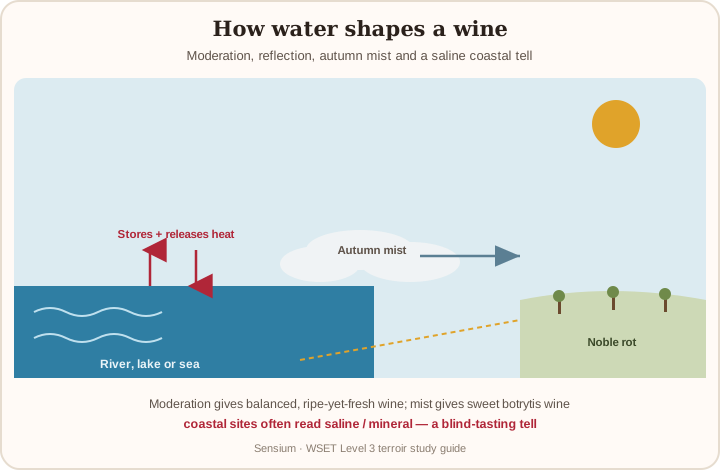
- Moderation. Large bodies of water heat up and cool down slowly, so they buffer temperature: warming cold nights and winters, cooling hot afternoons, reducing frost risk, and extending the ripening season. The result is balanced ripeness with retained acidity.
- Sunlight reflection. Rivers and lakes bounce sunlight back onto adjacent (often steep) slopes, adding ripening energy in cool, marginal regions — decisive on the steep river valleys of Germany and Austria.
- Humidity, mist and noble rot. Rivers and shallow lakes generate autumn morning fog; where it is followed by dry, sunny afternoons, it triggers Botrytis cinerea (noble rot), the engine behind the world's classic sweet wines.
- Cooling currents and breezes. Cold ocean currents chill the air and drive the sea breezes and fog that cool otherwise-warm coastal regions (the breezes themselves are covered in the winds guide; here the water is the source).
- Water supply (and disease). Rivers irrigate desert regions that could not otherwise grow vines, while damp maritime air raises humidity and fungal-disease pressure and brings vintage variation.
A strong answer states the water, the job, and the glass: "The cold Atlantic moderates Rías Baixas and drives humid breezes, retaining the high acidity and saline tang of Albariño while raising disease pressure that pergola training offsets."
France — Bordeaux and the South West
Bordeaux is defined by water on three scales — ocean, estuary, and river — and one cold tributary makes its sweet wines.
- The Atlantic Ocean gives Bordeaux its maritime climate: mild, damp, with vintage variation; the pine forest of Les Landes shelters the Médoc from the worst storms.
- The Gironde estuary and the Garonne + Dordogne rivers moderate temperature and reduce frost; they also name the wine — Left Bank and Right Bank are defined by which side of the water the gravel or clay sits on.
- The Ciron, a cold tributary, meeting the warmer Garonne generates the autumn morning mists over Sauternes and Barsac that, burned off by sunny afternoons, create the noble rot for sweet Sémillon-based wines — the syllabus's headline river-mist botrytis example.
France — Loire, Rhône, and the Mediterranean South
- Loire — the Loire River + the Atlantic. The river is a moderating thread the length of the region; at its Atlantic mouth, Muscadet is a genuinely maritime, often saline wine from Melon de Bourgogne. Inland, the cold Layon tributary brings the autumn mists for the botrytised Chenin Blanc of Coteaux du Layon, Bonnezeaux and Quarts de Chaume.
- Rhône — the Rhône River. It moderates the valley, reflects light, and famously channels the Mistral down its corridor (see the winds guide).
- Languedoc-Roussillon & Provence — the Mediterranean Sea. Maritime moderation tempers the heat; coastal lagoons matter too — Picpoul de Pinet grows beside the Étang de Thau lagoon and is a classic briny, Picpoul-driven seafood white.
- Champagne & Alsace — rivers over oceans. Champagne's Marne and Alsace's proximity to the Rhine give modest moderation in cool, marginal, rain-shadowed (Alsace) or continental (Champagne) climates.
Germany — the great reflecting rivers
Germany is the region where river reflection is the whole quality story, not a footnote.
- Mosel, Saar and Ruwer: these rivers bounce precious sunlight up onto the near-vertical slate slopes, moderate the cold continental climate, and let Riesling ripen at a latitude that would otherwise be too cold — the textbook river-reflection answer. Autumn river mists also feed the botrytis for BA and TBA.
- Rhine (Rheingau, Rheinhessen, Pfalz, Mittelrhein): a broad moderating, light-reflecting river for fuller-bodied Riesling and Pinot Noir.
- Lake Constance (Bodensee): moderates the far-southern region of Baden.
Austria and Hungary — rivers, and the lakes that make sweet wine
- Austria — the Danube (Wachau, Kremstal, Kamptal): moderates the steep terraces and reflects light for Grüner Veltliner and Riesling, while cool air off the northern woods meets the river's warmth for a wide diurnal range.
- Austria — Neusiedlersee (Burgenland): a large, shallow, warm lake that creates the humidity and autumn fog for reliable botrytis sweet wines, and moderates the reds of its shores.
- Hungary — Tokaj (Bodrog + Tisza): the confluence of these two rivers generates the persistent autumn mists that make the noble rot for sweet Furmint (Tokaji Aszú) — alongside Sauternes and the Mosel, one of the three classic botrytis river/lake set-pieces.
- Hungary — Lake Balaton: central Europe's largest lake, moderating and reflecting for the surrounding regions.
Italy — seas on three sides, lakes, and the Po plain
- Lake Garda (Veneto): moderates Bardolino, Lugana and Soave's neighbours and drives the cooling Ora breeze (winds guide).
- The Adriatic Sea moderates the eastern coast (Marche, Abruzzo, Puglia, Friuli); the Tyrrhenian/Mediterranean moderates the Tuscan coast (Bolgheri, Maremma), Campania and the islands.
- The Po valley gives Piedmont and Emilia their continentality (little maritime moderation), with river-fed autumn fog important for late-ripening Nebbiolo.
- Sicily and Sardinia are surrounded by sea — maritime moderation that keeps island whites such as Vermentino fresh and often saline.
Spain — the Atlantic, the estuaries, and the Ebro
- *Rías Baixas — the Atlantic + the rías (estuaries):* cold, wet, and breezy, giving high acidity and a saline character to Albariño, with humidity that forces pergola training for airflow.
- Jerez (Sherry) — the Atlantic + the Guadalquivir estuary + the Bay of Cádiz: the maritime humidity sustains the flor. Crucially, Manzanilla matured at Sanlúcar de Barrameda, right on the estuary mouth, is classically described as more saline and delicate than Fino from inland Jerez — a clean, examinable coastal-vs-inland tell for Palomino-based Sherry.
- Rioja — the Ebro River: moderates the valley and provides the water course around which the subregions sit; the Cantabrian range to the north (mountains guide) gates Atlantic influence.
- Ribera del Duero — the Duero River: a moderating thread through an otherwise extreme, high, continental plateau.
- Txakoli (País Vasco) & Catalonia: Atlantic (saline, coastal) in the Basque Country; Mediterranean moderation in Penedès and the Catalan coast.
Portugal — the Atlantic versus the sheltered Douro
- Douro (Port and dry reds) — the Douro River: historically the transport route for Port down to the lodges of Vila Nova de Gaia, and a modest moderating, reflecting presence in a hot, mountain-sheltered valley (the Marão range blocks the Atlantic).
- Vinho Verde — the Atlantic: cool, wet, and fresh, giving light, high-acid, faintly saline, often spritzy whites.
- Lisboa, Setúbal, Bairrada, Dão — the Atlantic + the Tagus (Tejo): maritime moderation, strongest near the coast and weaker behind the hills.
- Madeira — the Atlantic: a volcanic island wholly shaped by the surrounding ocean.
Greece and the eastern Mediterranean
- Santorini and the Aegean islands: surrounded by sea, giving maritime moderation and a saline edge to high-acid Assyrtiko — though here the Meltemi wind and volcanic soil (other guides) do more of the work than the water alone.
- Mainland coastal Greece takes Aegean and Ionian maritime moderation.
United States — oceans, the great rivers, and the Finger Lakes
- California — the Pacific + the cold California Current + San Pablo Bay: the ocean and its fog (pulled inland through the bay and coastal gaps — winds guide) are the single biggest cooling influence on an otherwise-warm state; the Russian River and bay fog define the coolest AVAs.
- Oregon & Washington — the Pacific and the Columbia River: the Pacific moderates the Willamette Valley; inland, the Columbia and Snake Rivers both irrigate the high desert of eastern Washington (viticulture would be impossible without them) and moderate frost near the water and in the Columbia Gorge.
- New York — the Finger Lakes: deep glacial lakes (Seneca, Cayuga) that store summer heat and release it in winter, protecting vines from the worst freezes and enabling cool-climate Riesling — the classic North American "lake effect" example. Lakes Erie and Ontario play the same role on their shores.
Canada — the lake-moderated cool climates
- Niagara (Ontario) — Lake Ontario + the Niagara Escarpment: the lake and the escarpment set up a circulation that moderates temperature and reduces frost, enabling table wines and icewine.
- Okanagan (BC) — Okanagan Lake: a long, deep lake that moderates a near-desert valley and protects against frost.
South America — the cooling Pacific and the irrigating rivers
- Chile — the Pacific + the cold Humboldt Current: the source of the fog and sea breezes that cool Casablanca, San Antonio/Leyda and Limarí for fresh Sauvignon Blanc and cool-climate Pinot; rivers (Maipo, Rapel and others) carry Andean meltwater that defines the valleys and irrigates them.
- Argentina — meltwater rivers, almost no maritime influence: landlocked high desert where the Andean rivers (Mendoza, Tunuyán) provide the meltwater irrigation that makes Malbec possible; with no moderating ocean, altitude (mountains guide) does the cooling. Patagonia's Río Negro valley adds a cooler, windier river-valley influence.
Australia and New Zealand — surrounded, and irrigated inland
- Australian coasts — the Southern and Indian Oceans, gulfs and straits: maritime cooling for Margaret River, the Limestone Coast (Coonawarra), McLaren Vale (Gulf St Vincent), the Hunter (Pacific, humid) and especially Tasmania (Bass Strait/Southern Ocean), Australia's coolest, most maritime state.
- Inland Australia — the Murray-Darling river system: irrigates the high-volume warm-inland regions (Riverland, Riverina, Murray Darling) that supply much of the country's everyday wine.
- New Zealand — surrounded by the Pacific and Tasman Seas: thoroughly maritime and cool, with the ocean keeping Marlborough fresh; in Central Otago, inland lakes (Dunstan, Wānaka) moderate the country's only continental, frost-prone region.
South Africa and England
- South Africa — the cold Atlantic (Benguela Current) + the Indian Ocean: the cold current and bays (False Bay, Walker Bay for Hemel-en-Aarde) cool the coastal Cape regions and drive the sea breezes that bring freshness to a sunny climate.
- England — the English Channel + the Atlantic: a cool, marginal maritime climate on chalk soils (continuous with Champagne's), increasingly successful for traditional-method sparkling.
How water shows up in the glass: blind-tasting tells (including salinity)
This is the section you asked for — what water actually does to a wine you are assessing blind. Work it across four cues.
- Saline / briny character — the coastal tell. Many coastal and maritime wines are described as saline, briny, or "sea-spray" salty, and it is one of the most useful regional tells in the syllabus: think Muscadet, Vinho Verde, Rías Baixas Albariño, Basque Txakoli, Picpoul de Pinet beside its lagoon, coastal Vermentino, Santorini Assyrtiko, and Manzanilla from seaside Sanlúcar. Be honest about the science: there is no firm evidence that sea salt blows onto the grapes, and WSET does not teach a proven mechanism — "salinity" is partly a perception and an association. But the association is reliable enough that a high-acid white with a salty, mineral finish should push your guess toward a cool, coastal/maritime origin. The Manzanilla-vs-Fino contrast (saltier from the estuary mouth) is the cleanest exam example.
- *Moderation — ripeness with freshness. Strong water moderation lets fruit ripen fully while the cool nights and long season retain acidity, so the blind signature is balanced ripeness, fresh-to-high acidity, and moderate alcohol* rather than the soft, high-alcohol, low-acid profile of a hot continental site. A wine that is ripe yet notably fresh and balanced suggests an ocean-, sea- or lake-moderated home.
- Noble rot — the river/lake-mist sweet-wine tell. Honey, beeswax, dried apricot, marmalade, saffron and ginger over searingly high acidity is the fingerprint of botrytis, and botrytis means a river- or lake-fog zone: Sauternes (Ciron + Garonne), Tokaj (Bodrog + Tisza), Coteaux du Layon (Layon), German BA/TBA (Mosel/Rhine), Neusiedlersee. Smell noble rot, and you should be thinking "morning-mist water body."
- Reflection and dilution — the structural edges. River-reflected slopes (Mosel, Wachau, Douro) can give riper, fuller wines than the cool latitude predicts — a useful nuance when a Riesling seems riper than "northern" would suggest. Conversely, a damp maritime vintage or a heavily irrigated inland river region can read dilute, lighter, and simpler, pointing to a wet Atlantic year or a high-volume irrigated zone (Murray-Darling) rather than a concentrated dry-farmed site.
The discipline matches the other terroir chapters: lead with structure (acidity, body, alcohol, balance), use saline/mineral character as a coastal confirmer, and treat noble-rot aromas as a near-definitive pointer to a mist-making body of water.
Quick-reference water table
| Body of water | Region(s) | Job | Blind-tasting consequence |
|---|---|---|---|
| Atlantic Ocean | Bordeaux, Muscadet, Vinho Verde, Rías Baixas, Cape (SA) | Maritime moderation + humidity | Balanced ripeness + fresh acid; saline coastal whites; vintage variation |
| Mediterranean Sea | Languedoc, Provence, coastal Italy/Spain | Warm maritime moderation | Riper but sea-tempered; saline coastal whites (Picpoul, Vermentino) |
| Gironde estuary + Garonne/Dordogne | Bordeaux | Moderation, frost reduction, names the banks | Balanced Left/Right Bank reds |
| Ciron + Garonne mists | Sauternes/Barsac | Autumn fog → noble rot | Honeyed, high-acid sweet Sémillon |
| Loire River + Layon | Loire | Moderation; tributary mist → botrytis | Fresh whites; botrytised sweet Chenin |
| Mosel / Saar / Ruwer | Germany | Light reflection onto slate + moderation | Riper-than-latitude, high-acid Riesling |
| Danube | Wachau/Kremstal/Kamptal | Moderation + reflection | Fresh, structured Grüner/Riesling |
| Neusiedlersee | Burgenland | Shallow warm lake → fog → botrytis | Reliable botrytis sweet wines |
| Bodrog + Tisza | Tokaj | River confluence mist → noble rot | Honeyed, high-acid sweet Furmint |
| Lake Garda | Veneto | Moderation + Ora breeze | Fresh, lifted whites/light reds |
| Guadalquivir estuary / Bay of Cádiz | Jerez/Sanlúcar | Maritime humidity sustains flor | Saline, delicate Manzanilla vs inland Fino |
| Pacific + Humboldt/California Currents | Chile, California, Oregon | Cold-current fog + sea breeze | Cool, high-acid, fresh styles in warm latitudes |
| Columbia / Murray-Darling / Andean rivers | Washington, inland Australia, Argentina | Irrigation of desert (+ frost moderation) | Enables ripening; high-volume = dilute/simple |
| Finger Lakes / Lake Ontario / Okanagan Lake | New York, Niagara, BC | Lake-effect moderation + frost protection | Cool-climate, high-acid Riesling + icewine |
| Southern/Tasman/Indian Oceans | Australia, New Zealand | Maritime cooling | Fresh, balanced, often high-acid |
Frequently asked questions
Why do some wines taste salty or saline?
Many coastal and maritime wines — Muscadet, Vinho Verde, Rías Baixas Albariño, Basque Txakoli, Santorini Assyrtiko, seaside Manzanilla — read saline. There is no proven mechanism of sea salt reaching the grape, so it is partly perception and association, but a high-acid white with a salty, mineral finish reliably points to a cool, coastal origin.
How do bodies of water affect wine?
Large bodies of water moderate temperature (balanced ripeness with fresh acidity), reflect sunlight onto slopes, generate autumn mist for noble rot, drive cooling currents and breezes, and irrigate desert regions that could not otherwise grow vines.
What causes noble rot?
Botrytis cinerea, triggered by autumn morning fog — usually from a river or shallow lake — followed by dry, sunny afternoons. It is the engine behind Sauternes, Tokaji and German BA/TBA sweet wines.
What is the lake effect in wine?
Deep lakes such as New York's Finger Lakes store summer heat and release it slowly in winter, protecting vines from extreme freezes and enabling cool-climate Riesling and icewine.
Why is Bordeaux's climate maritime?
The Atlantic Ocean and the Gironde estuary moderate its temperature and bring humidity, giving a mild, damp climate with noticeable vintage variation.
How to lock the water bodies into memory
Water facts stick when you pair each body with its job and the style cue it leaves in the glass. Drill them the active way: name a region, then say the water, the job (moderation / reflection / mist-botrytis / cooling current / irrigation), and the blind tell — saline finish, ripe-yet-fresh balance, noble rot, or dilute simplicity — before you check. The Compare grapes surface is ideal for the saline contrasts: line up a coastal Albariño against an inland white and articulate why one reads briny. Then run the recall under the clock on the Train surface.
This is the water chapter of terroir; it completes the set with WSET Level 3 soils: every region's vineyard ground, WSET Level 3 winds: how air shapes every wine region, and WSET Level 3 mountains: altitude, rain shadow and aspect — water often drives the winds (sea breezes) and makes the sweet wines the other chapters can't. The whole terroir block slots into the revision calendar in How to study for WSET Level 3 in 60 days.
Further reading: on the contested science of "minerality" and saline character, see the reference wine writing of Master of Wine Jancis Robinson.
Make the water tells automatic. Recall each region's body of water and its glass-cue under time pressure in Sensium's Train mode, and compare the saline, moderated, and botrytised styles side by side in Compare.